
Publikationen
Es wurden 679 Einträge gefunden.
Bridging technologies on the way to a climate neutral future
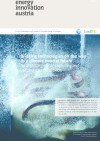
New strategies for capturing and utilizing carbon dioxide
energy innovation austria
4/2017
Herausgeber: BMVIT und Klima- und Energiefonds
Englisch, 8 Seiten
Downloads zur Publikation
Efficient use of biogenic resources
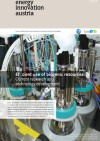
Current research and technology development
energy innovation austria
3/2017
Herausgeber: BMVIT und Klima- und Energiefonds
Englisch, 8 Seiten
Downloads zur Publikation
Innovative Energy Technologies in Austria - Market Development 2016
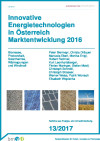
Biomass, photovoltaic, solar thermal collectors, heat pumps and wind power
13/2017
Peter Biermayr, Christa Dißauer, Manuela Eberl, Monika Enigl, Hubert Fechner, Kurt Leonhartsberger, Florian Maringer, Stefan Moidl, Christoph Schmidl, Christoph Strasser, Werner Weiss, Patrik Wonisch, Elisabeth Wopienka
Herausgeber: BMVIT
Deutsch, 242 Seiten
Downloads zur Publikation
Photovoltaics - a key technology
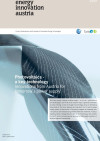
Innovations from Austria for tomorrow`s power supply
energy innovation austria
2/2017
Herausgeber: BMVIT und Klima- und Energiefonds
Englisch, 8 Seiten
Downloads zur Publikation
Building innovations from Austria
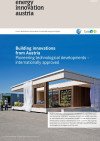
Pioneering technological developments – internationally approved
energy innovation austria
1/2017
Herausgeber: BMVIT und Klima- und Energiefonds
Englisch, 8 Seiten
Downloads zur Publikation
University Plus-Energy Office High-Rise Building
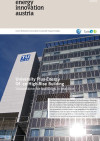
Innovations for buildings in practice
Herausgeber: BMVIT und Klima- und Energiefonds
Englisch, 8 Seiten
Downloads zur Publikation
Systemic renovation in the social housingsector
This project treats a global renovation of a residential estate built in the 1960s in the context of council housing in a laggard region. The point is to optimise with a systemic approach in a interdisciplinary team all partitions which include habitation.
Criteria for Sustainable Urban Development - Tool for the Development and Assessment of urban brownfields
Based on experiences made with the projects "solarCity" and "Eco Building" resp. "Total Quality Assessment" the project will define qualitative and quantitative criteria for sustainable urban development considering Greater Linz as example.
Construction Elements and Building Materials for Buildings with High-Level Thermal Insulation - Technology, Building Physics, Ecological Rating, Costs (in Austria)
Catalogue of construction elements for buildings specified according to the passive house standard: proven elements and connections , examined for technical and physical reliability, with evaluated life cycle ecology. Cost assessments (for Austria). Guidelines for building contractors regarding airtightness, etc.
Factors which hinder and support the market introduction of innovative residential building concepts - an information offensive for planners and technology producers.
In order to actively increase the diffusion of innovative residential buildings, the results of currently available research were summarised to produce a "'diffusion campaign", directed at building planners, residential building contractors and selected technology producers.
Innovations for the city of tomorrow
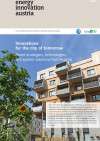
Smart strategies, technologies and system solutions from Austria
energy innovation austria
4/2016
Herausgeber: BMVIT und Klima- und Energiefonds
Englisch, 16 Seiten
Downloads zur Publikation
Energy-storage concrete: Thermal Component Activation
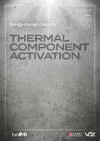
This planning guide provides information on the option of solely heating and cooling small-volume residential buildings by means of thermal component activation (TCA). Concrete instructions on the planning of residential buildings with thermally-activated ceilings are also provided.
Felix Friembichler, Simon Handler, Klaus Krec, Harald Kuster
Herausgeber: BMVIT
Englisch, 122 Seiten
Downloads zur Publikation
IEA-4E Jahresbericht 2015
Herausgeber: IEA - 4E
Englisch, 39 Seiten
Downloads zur Publikation
IEA-EBC Newsletter, Issue 63, Juni 2016
Herausgeber: IEA-EBC Programme
Englisch, 16 Seiten
Downloads zur Publikation
IEA EBC Annex 62: Konferenzbeitrag: "Ventilative Cooling Potential"
Auf der internationalen Konferenz Sustainable Building Europe 2016, in Hamburg, wurden die Ergebnisse aus der theoretischen und praktischen Analyse des Ventilative Cooling Potentials, speziell für Österreich und speziell für NZEBs diskutiert.
Peter Holzer
Herausgeber: Institute of Building Research & Innovation, Wien
Englisch, 11 Seiten
Downloads zur Publikation
International Ventilation Cooling Application Database
Dargestellt werden die aktuellen Ergebnisse der Evaluation der Ventilative Cooling Application Database. Diese besteht aus internationalen Projekten, die Ventilative Kühlung einsetzen und gibt Aufschluss über die Implementierung dieser Kühlstrategie. Neben statistischen Größen werden auch Angaben über technische Komponenten die zur Anwendung kamen erfasst und ausgewertet.
Peter Holzer, Theofanis Psomas, Paul O'Sullivan
Englisch, 9 Seiten
Downloads zur Publikation
Solar Heat Worldwide - Markets and Contribution to the Energy Supply 2014
Edition 2016
Herausgeber: IEA Solar Heating & Cooling Programme
Englisch, 73 Seiten
Downloads zur Publikation
Report "Photovoltaic and Solar Forecasting: State of the Art" (2013)
Dieser Bericht beschreibt den aktuellen Stand der Technik für solare Vorhersagemodelle und -methoden im internationalen Kontext. Diese Methoden sind auch für Leistungsprognosen von Photovoltaik geeignet und bieten unterschiedliche zeitliche Auflösungen in der Vorhersage, von wenigen Minuten bis einigen Tagen.
Herausgeber: IEA Photovoltaic Power Systems Programme
Englisch, 40 Seiten
Downloads zur Publikation
Report "High Penetration PV in local Distribution Grids: Case-Study Collection" (2014)
Im Rahmen von Task 14 wurden Fallstudien zur Netzintegration von Photovoltaik in elektrischen Verteilnetzen erarbeitet. Daten aus 11 Ländern weltweit wurden gesammelt und für eine vergleichende Analyse aufbereitet, welche in diesem Bericht zusammengefasst ist.
Herausgeber: IEA Photovoltaic Power Systems Programme
Englisch, 206 Seiten
Downloads zur Publikation
Report "Transition from Uni-Directional to Bi-Directional Distribution Grids: Management Summary of IEA Task 14 Subtask 2 - Recommendations based on Global Experience" (2014)
Um den Anteil von Photovoltaik in elektrischen Verteilnetzen weiter zu erhöhen werden in diesem Bericht technische Implementierungsmöglichkeiten erläutert. Die Herausforderungen auf unterschiedlichen Spannungsebenen im Verteilnetzbetrieb werden darin erläutert und Konzepte aufgezeigt die in einigen Ländern bereits umgesetzt wurden, um den Übergang von unidirektionalen zu bidirektionalen Verteilnetzen zu ermöglichen.
Herausgeber: IEA Photovoltaic Power Systems Programme
Englisch, 35 Seiten